
Delaware and Wilmington Named Among Nation’s Most Arts-Vibrant by SMU DataArts
Delaware Ranks 11th of 50 States and Wilmington 57th of 100 Communities in 10th Annual Arts Vibrancy Index
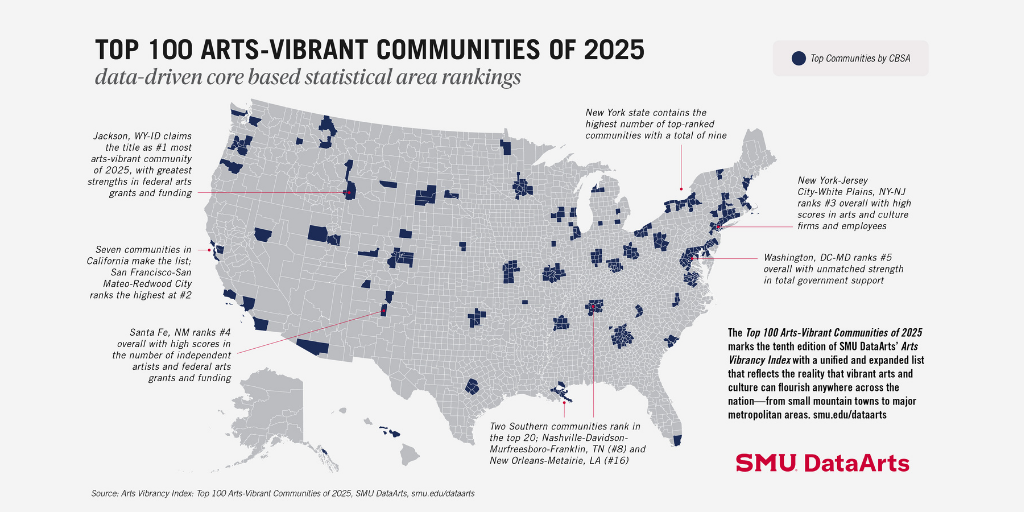
STATEWIDE, Del., [June 25, 2026] – SMU DataArts, the National Center for Arts Research, released its 10th annual Arts Vibrancy Index, which ranks Delaware 11th in the nation for arts vibrancy among the 50 states and recognizes Wilmington as #57 on its expanded list of the 100 most arts-vibrant communities in the United States. The rankings are based on a data-driven approach that analyzes the level of supply, demand, and government support for the arts using data available in more than 900 communities across the country.
“That Delaware ranks 11th in the nation for arts vibrancy reflects what sustained public investment in the arts can produce,” said Jessica Ball, Director of the Delaware Division of the Arts. “Through annual appropriations from the Delaware General Assembly, our federal partnership with the National Endowment for the Arts, and the work of grantees in every corner of the state, Delaware has built a cultural infrastructure of national consequence. We’re proud to see Wilmington recognized alongside the state, and we congratulate the organizations, artists, and audiences whose sustained engagement made these rankings possible.”
From the galleries of the Delaware Art Museum, to the stages of the Grand Opera House, Delaware Theatre Company, OperaDelaware, and the Delaware Symphony Orchestra, Wilmington supports a remarkably broad cultural footprint for a city its size. Community-rooted institutions like the Christina Cultural Arts Center, The Music School of Delaware, and First State Ballet Theatre extend that creative reach into neighborhoods and classrooms across the city, and signature events like the Clifford Brown Jazz Festival draw audiences from across the region each year. Together with Wilmington’s broader community of individual artists, designers, and arts workers, Delaware’s non-profit and for-profit arts organizations map directly onto the three pillars the AVI measures: cultural supply, audience and revenue demand, and sustained public investment.
The Index reflects fluctuations in arts activity, participation, funding, access and employment that occurs in each community and consistently shows that highly arts-vibrant communities are dispersed broadly throughout the U.S., with every region of the country represented in the top rankings. This finding arises naturally out of objective analysis of the data, not from any selection of communities to achieve geographic representation. From Ohio to Colorado, New York to Alaska, arts vibrant communities recognize regional artistic diversity and community success.
To mark the 10th anniversary of AVI, SMU DataArts has expanded the list to 100 communities, up from 40 in previous years, and for the first time has analyzed and ranked all 50 states. Delaware’s placement among the top dozen reflects the cumulative impact of state and federal public investment, philanthropic support, and a dense network of nonprofit cultural producers across all three counties. To delve into the details and visualize community and state index data in depth, visit the data explorer.
“The Arts Vibrancy Index has shone a light on the people, organizations, and investments that make local culture vibrant for the last 10 years,” stated Dr. Jennifer Benoit-Bryan, Executive Director of SMU DataArts. “By expanding our list to one hundred geographically diverse communities, we celebrate the top 10 percent of arts-vibrant communities nationwide. Through all the ups and downs of the last decade, communities have continued to celebrate and invest in their local arts, and the index has provided data-backed insights to inform planning, advocacy, and well-deserved recognition. We look forward to building on this history as this resource evolves with the sector going forward.”
The Arts Vibrancy Index is composed of 13 unique measures which cover aspects of supply, demand, and public support for arts and culture, and are adjusted for cost of living and population differences among communities. Communities are measured using Core Based Statistical Areas (CBSAs), which are metropolitan and micropolitan regions defined by the U.S. Census Bureau that capture the economic and cultural reach of a county or group of counties and their socially-integrated surrounding areas. For more information on how the Arts Vibrancy Index is calculated, metrics, data sources, more detail on specific communities and the data explorer, please visit https://culturaldata.org/arts-vibrancy-2025.
###
ABOUT SMU DATAARTS
SMU DataArts, the National Center for Arts Research, is a project of the Meadows School of the Arts at Southern Methodist University. The mission of SMU DataArts is to provide the evidence-based insights needed to collectively build strong, vibrant, and equitable arts communities. Its research efforts range from academic papers published in leading journals, applied research undertaken with community partners, and actionable insights shared directly with arts practitioners. Its programs provide business intelligence tools and resources to help arts leaders leverage data to answer critical management questions and connect research analyses to their own work. Recent publications include research reports on the scope of federal COVID-19 relief funding for the arts; national operating trends for arts and cultural organizations the alchemy that drives high performing arts organizations of color; audience diversity, equity and inclusion in large performing arts organizations; impact of investments made in diverse creative communities; and more.
Contact: Emma England, Meadows School of the Arts, 214-768-3785, eengland@mail.smu.edu
About the Delaware Division of the Arts
The Delaware Division of the Arts is an agency of the State of Delaware. Together with its advisory body, the Delaware State Arts Council, the Division administers grants and programs that support arts programming, educate the public, increase awareness of the arts, and integrate the arts into all facets of Delaware life. Funding for Division programs is provided by annual appropriations from the Delaware General Assembly and grants from the National Endowment for the Arts, a federal agency. For more information about the Delaware Division of the Arts, visit arts.delaware.gov or call 302-577-8278.
Contact: Andy Truscott, Program Officer, Marketing and Communications, Delaware Division of the Arts, 302-577-8280, andrew.truscott@delaware.gov
Legal Disclaimer:
EIN Presswire provides this news content "as is" without warranty of any kind. We do not accept any responsibility or liability for the accuracy, content, images, videos, licenses, completeness, legality, or reliability of the information contained in this article. If you have any complaints or copyright issues related to this article, kindly contact the author above.
