

62% of Families Are Cutting Back on Meat & Seafood as Grocery Prices Rise, New Survey Finds
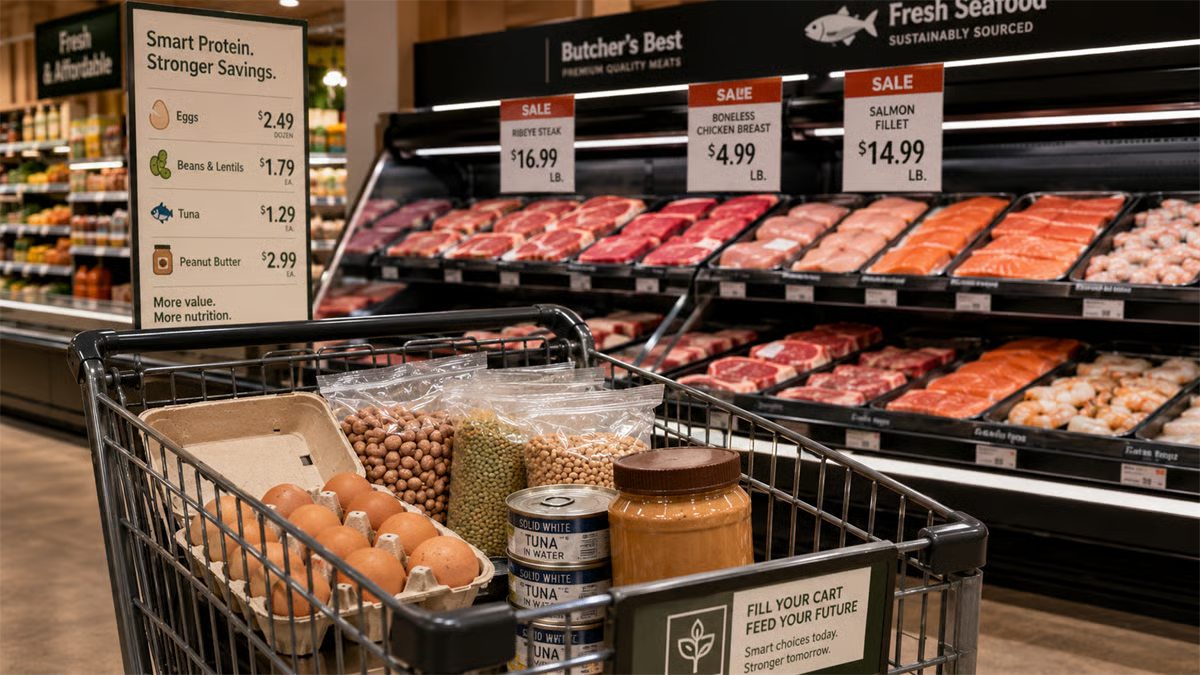
Survey of 3,042 U.S. households commissioned by MarketBeat to find out how rising grocery costs are affecting household protein purchases and eating habits.
Meat has traditionally been treated as a basic part of the weekly grocery shopping, but our findings show that many households are now approaching it as an expense that must be carefully managed.”
SIOUX FALLS, SD, UNITED STATES, October 5, 2026 /EINPresswire.com/ -- Recent reports have highlighted how rising grocery prices are forcing families to cut back on fresh fruit and vegetables. However, new research suggests that households are buying less animal protein, instead switching to plant-based sources, cheaper alternatives or serving smaller portions.— Matt Paulson, founder of MarketBeat.
That is according to a survey of 3,042 U.S. households commissioned by MarketBeat, a financial media company, which found that 62% have lowered the amount or type of meat, seafood or dairy they purchase because of rising grocery prices over the past 12 months.
Animal protein sits at the center of both the household grocery budget and the wider consumer economy. Meat and seafood are among the more expensive essentials Americans purchase each week, meaning they are often among the first items to be swapped, stretched, downgraded or reduced when prices rise.
Households in Arkansas Are Cutting Back the Most
The impact varies significantly across the country. Arkansas recorded the highest proportion of households cutting back on meat, seafood, and dairy, at 82%, followed by Maine at 80% and Oregon at 77%.
Alaska and Montana were tied at 75%, while Kentucky, Nebraska and Oklahoma each recorded figures of 73%. West Virginia followed at 72%, with California at 71% and Texas at 70%.
At the other end of the ranking, just 22% of households in New Hampshire and North Dakota said they had reduced their meat, seafood and dairy purchases. Hawaii recorded the next-lowest figure, at 33%, followed by Idaho at 40% and Delaware at 43%.
Even in states with comparatively lower figures, however, the results indicate that a substantial number of households are reconsidering how much meat, seafood or dairy they can afford and which products still fit within their weekly grocery budgets.
Beef Is Taking the Biggest Hit
Beef is by far the protein source that households have cut back on the most. Among respondents, 43% identified beef as the main protein they had reduced, compared with 10% who selected fish or seafood and 8% who named chicken or turkey, followed by pork at 8% and dairy at 7%.
The findings suggest that households are not abandoning animal protein altogether but are becoming more selective, particularly with higher-priced products such as beef and seafood. Nearly half of respondents (47%) said their household had replaced beef with a vegetarian protein source, such as beans or lentils, because of price increases.
“Beef has become one of the first places families feel pressure in the protein budget,” Paulson says. “When prices rise, people reduce or replace. The fact that almost half have switched from beef to a vegetarian alternative shows how quickly an everyday purchase can become an occasional one.”
Meat-Free Meals Are Becoming a Money-Saving Strategy
Serving meals without meat or fish has become a regular cost-saving measure for many households. More than half of respondents (51%) said their household now serves a meal without meat or fish at least twice a week, specifically to save money.
This includes 10% who do so every day, 13% who serve meat-free or fish-free meals four to six times per week and 28% who do so two or three times per week.
A further 16% serve such a meal once per week, while 11% do so less frequently. Only 22% said they never serve a meal without meat or fish specifically for financial reasons. The results suggest that what may once have been an occasional dietary choice is increasingly becoming a routine budgeting strategy.
Some Adults Are Giving Up Their Own Portions
The financial pressure surrounding meat and seafood is also affecting how food is divided within households. More than half of respondents (58%) said they had personally eaten a smaller portion or skipped a protein-rich food so their children or another household member could have more.
This finding illustrates that the protein squeeze is not simply changing shopping lists. In many households, it influences who eats what once the groceries reach the table.
Matt Paulson says: “This may be the most concerning finding in the survey. People are not only changing what they buy. Many are eating less themselves so someone else in the household can have more.”
Eggs Are the Most Common Budget Fallback
When households need a more affordable protein alternative, eggs are the most popular option. Almost one-quarter of respondents (24%) named eggs as their household’s main budget fallback. Processed meats such as hot dogs or deli meat followed at 13%, while 12% selected beans.
Canned tuna or other canned fish was chosen by 9%, followed by peanut butter at 8%, dairy products at 4%, protein powder at 3%, and lentils at 2%.
Another 24% said their household did not have a regular budget to fall back on.
While some of the most commonly selected alternatives are lower-cost staples such as eggs and beans, the results also show that households are turning to processed products that may offer convenience and affordability when fresh meat or fish is beyond the weekly budget.
Weekly Discounts Are Dictating What Families Eat
For many Americans, the decision over what protein to purchase is now driven primarily by supermarket promotions rather than personal preference or meal planning.
Seven in ten respondents (70%) said they now decide what protein to buy mainly based on what is discounted that week. This reliance on promotions may help households maintain some variety, but it also suggests that consumers are becoming more exposed to changing prices and less able to purchase the same foods consistently.
Animal Protein Is Starting to Feel Like a Luxury
Two-thirds of respondents (67%) said rising prices had made meat, seafood and dairy feel more like a luxury than a basic grocery item. The finding reflects how foods traditionally seen as everyday staples can gradually become discretionary purchases when household budgets are stretched. Rather than asking which meat, fish or dairy product they prefer, many shoppers are now asking whether they can afford to include it at all.
Laycee Kluin, Media Relations
MarketBeat.com
+1 844-978-6257
email us here
Visit us on social media:
LinkedIn
Instagram
Facebook
YouTube
X
Legal Disclaimer:
EIN Presswire provides this news content "as is" without warranty of any kind. We do not accept any responsibility or liability for the accuracy, content, images, videos, licenses, completeness, legality, or reliability of the information contained in this article. If you have any complaints or copyright issues related to this article, kindly contact the author above.
